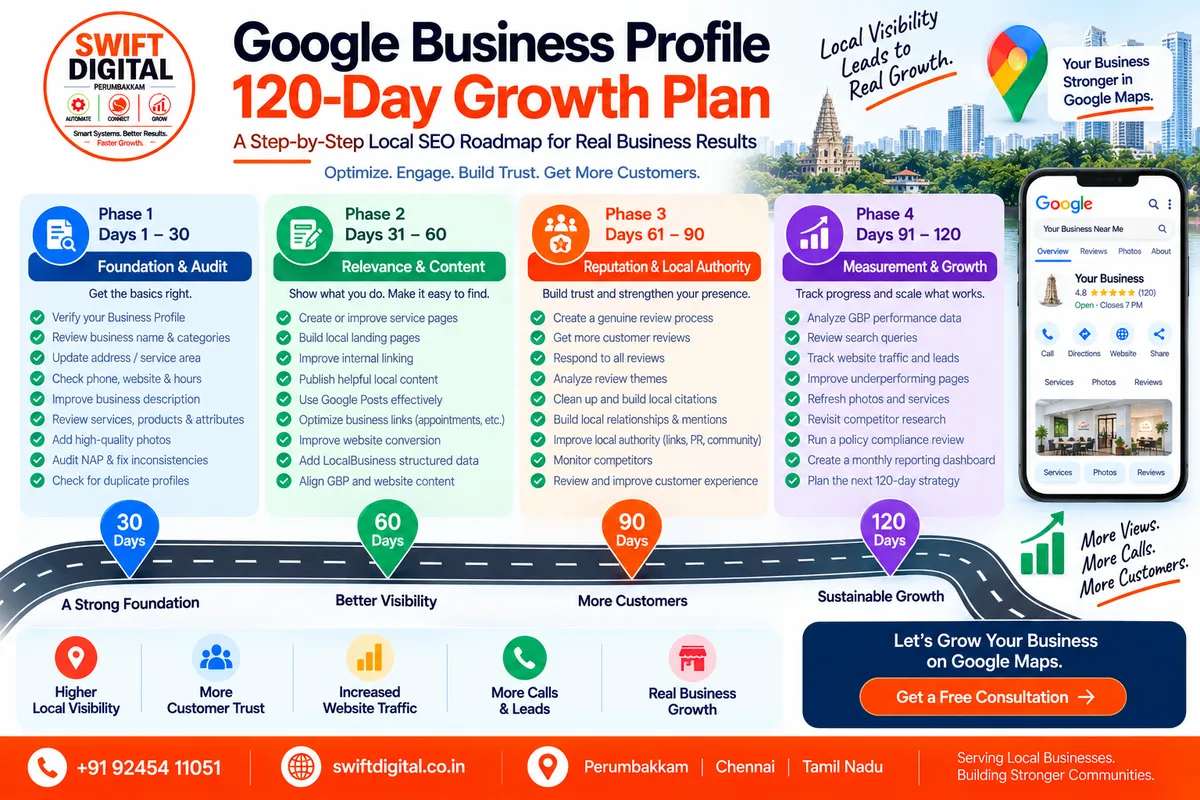
Google Business Profile 120-Day Growth Plan: Complete Local SEO Roadmap
Optimizing a Google Business Profile isn't a one-time task.
Your business information changes. Customers leave new reviews. Competitors publish new content. Your website evolves. Google may also receive business information from multiple sources across the web.
A sustainable local SEO strategy therefore requires ongoing optimization, monitoring, testing, and improvement.
Google says local results are primarily based on relevance, distance, and prominence, and recommends keeping Business Profile information complete and accurate.
This 120-day roadmap gives you a structured way to improve your Google Business Profile and supporting local SEO assets without relying on shortcuts, fake reviews, keyword stuffing, or ranking manipulation.
Important: No 120-day plan can guarantee a particular Google Maps position. Local results depend on multiple factors, including the searcher's location and the business's relevance and prominence.
What Is a Google Business Profile Growth Plan?
A GBP growth plan is a structured schedule for improving and maintaining:
Business Profile information
Categories
Services
Products where applicable
Attributes
Photos and videos
Reviews
Website
Local landing pages
Citations
Local content
Local authority
Customer experience
Performance tracking
Instead of making random changes, you work through these areas systematically.
The 120-Day Strategy
The plan is divided into four phases:
Days 1–30
Foundation & Audit
Days 31–60
Relevance & Content
Days 61–90
Reputation & Local Authority
Days 91–120
Measurement & Growth
Each phase builds on the previous one.
Before You Start: Establish Your Baseline
Before changing anything, record your current situation.
Create a spreadsheet containing:
Metric | Starting Value |
|---|---|
Profile verification | Yes/No |
Primary category | Current category |
Additional categories | Number |
Reviews | Current count |
Rating | Current rating |
Photos | Current count |
Website clicks | Baseline |
Calls | Baseline |
Directions | Baseline |
Profile views | Baseline |
Search queries | Baseline |
Website organic traffic | Baseline |
Leads | Baseline |
Google's Performance reporting provides applicable metrics such as searches, views, calls, website clicks, directions, messages and bookings. You can select date ranges and download performance data for analysis.
Phase 1: Days 1–30 — Build the Foundation
The first month is about getting the fundamentals right.
Don't begin with advanced tactics while your basic business information is inaccurate.
Days 1–3: Verify Your Business Profile
Confirm:
Profile exists
Profile is claimed
Profile is verified
Correct Google account has access
Authorized people have appropriate access
No duplicate profile exists
Google states that verified businesses can manage their information on Google, and only eligible businesses should create or claim Business Profiles.
Priority: Critical
Days 4–5: Audit the Business Name
Make sure the name represents the business's real-world name.
Avoid adding:
Keywords
Locations
Phone numbers
Promotional phrases
Services that aren't part of the actual name
The objective is accuracy—not keyword manipulation.
Priority: High
Days 6–7: Review Your Primary Category
Ask:
What is the core business?
Select the category that most accurately represents that business.
Don't choose a category simply because you believe it has higher search volume.
Priority: High
Days 8–9: Review Additional Categories
Check whether additional categories accurately describe the business.
Remove irrelevant categories.
Don't add categories merely because competitors use them.
Priority: High
Days 10–11: Audit Business Information
Check:
Business name
Address
Phone
Website
Hours
Service area
Map location
Appointment/contact options
Google recommends complete and accurate Business Profile information because it helps Google match businesses to relevant local searches.
Priority: High
Days 12–13: Audit Business Description
Your description should explain:
What the business does
Who it serves
Important services/products
Relevant business information
Use natural language.
Don't turn the description into a list of keywords.
Priority: Medium
Days 14–15: Audit Services
Review every service.
Ask:
Do we actually provide this?
Is the service name clear?
Is the description useful?
Does our website support this service?
Is anything outdated?
Remove services that are no longer offered.
Priority: High
Days 16–17: Audit Products
If Products are relevant to the business:
Review product names
Update images
Check descriptions
Review pricing where applicable
Remove discontinued products
If the business is service-based, don't create artificial products just for SEO.
Days 18–19: Audit Attributes
Review applicable attributes.
Only select attributes that accurately describe the business.
Examples can include:
Accessibility
Payment options
Amenities
Service options
Days 20–21: Audit Photos
Create a photo inventory:
Logo
Cover
Exterior
Interior
Products
Services
Team
Work examples
Google recommends using photos to help customers understand the business and its products or services.
Prioritize authentic photographs over generic stock imagery.
Days 22–23: Review Website Connection
Make sure your website:
Represents the same business
Has correct contact information
Works on mobile
Loads correctly
Uses HTTPS
Contains useful service information
Has a clear conversion path
Google can use information from a business's official website and other sources when compiling local information.
Days 24–25: Audit NAP
Check:
Name
Address
Phone
Compare your information across:
Website
GBP
Local directories
Social profiles
Industry listings
Relevant business organizations
Correct important inconsistencies.
Days 26–27: Check for Duplicate Profiles
Search Google Maps using:
Business name
Business name + city
Phone number
Address
Old business name
Document any duplicate or outdated listing that needs attention.
Days 28–30: Complete the Foundation
At the end of Month 1, your goal is to have:
Accurate profile information
Appropriate categories
Correct services
Correct website
Accurate hours
Accurate service area
Consistent NAP
Authentic photos
No obvious duplicate profiles
No obvious policy problems
Phase 2: Days 31–60 — Improve Relevance & Content
The second month focuses on helping customers—and Google—understand the business more clearly.
Google describes relevance as how closely a Business Profile matches what someone is searching for. Complete and detailed information helps Google understand the business.
Days 31–35: Build Your Service Content
For every important service, create or improve a website page where justified.
For example:
/services/ local-seo/ google-business-profile-optimization/ website-development/ marketing-automation/Each page should explain the actual service.
Don't create pages simply because a keyword exists.
Days 36–40: Build Local Landing Pages
Where there is a legitimate reason for a dedicated location page, create useful local content.
Examples:
/locations/chennai/
/locations/perumbakkam/
/locations/medavakkam/
Each page should contain genuinely useful local information.
Avoid creating dozens of pages with identical content and only changing the city name.
Days 41–43: Improve Internal Linking
Connect relevant pages:
Homepage ↓
Service Page ↓
Location Page ↓
Contact / Conversion Page
Also link relevant blog articles to your service and location pages.
This creates a logical website structure for visitors and search engines.
Days 44–46: Create a Local Content Calendar
Build topics around actual customer questions.
Examples:
How to choose a local SEO agency
Google Business Profile verification
Google Maps SEO
Google reviews
Local SEO for small businesses
GBP services
Local landing pages
Common local SEO mistakes
The objective is useful content—not publishing for the sake of volume.
Days 47–50: Publish Google Business Profile Content
Where Posts are available and useful, publish relevant:
Updates
Offers
Events
New services
Helpful information
Customer-focused announcements
Keep content accurate and useful.
Don't assume that publishing a certain number of posts automatically produces higher rankings.
Days 51–53: Improve Customer Conversion
Review the journey:
Google Search → GBP → Website → Contact → Customer
Check whether customers can easily:
Call
Visit
Request information
Book where applicable
View services
Understand pricing/process
Find business hours
Google provides Business Profile links that can help eligible businesses direct customers to actions such as appointments, reservations, ordering, or service information.
Days 54–56: Review Business Links
Check applicable:
Website
Appointment link
Booking link
Reservation link
Ordering link
Service/menu link
Google's business-link guidelines say applicable action links should lead to dedicated landing pages for the business and, for multi-location businesses, the relevant location.
Days 57–60: Add or Improve LocalBusiness Structured Data
Where appropriate, review structured data on your website.
Google recommends using the most specific applicable LocalBusiness subtype and accurately representing the business information on the page.
Remember:
Structured data helps search engines understand content; it is not a guaranteed ranking boost.
Phase 3: Days 61–90 — Reviews, Reputation & Local Authority
Month 3 focuses on reputation and the broader local presence.
Days 61–65: Build a Genuine Review Process
Create a repeatable customer review request process.
Possible channels:
Email
SMS
WhatsApp
QR code
Post-purchase follow-up
Google allows businesses to request reviews using a review link or QR code.
The important principle is:
Ask for genuine feedback without incentives or manipulation.
Days 66–70: Respond to Existing Reviews
Create a review-response workflow.
Positive Review
Thank the customer and acknowledge something specific where appropriate.
Neutral Review
Thank them and address the feedback.
Negative Review
Remain professional, acknowledge the concern, and move the detailed conversation to an appropriate private channel when necessary.
Never argue publicly with customers.
Days 71–73: Analyze Review Themes
Don't look only at star ratings.
Categorize customer feedback.
For example:
Theme | Positive | Negative |
|---|---|---|
Service speed | ✓ | |
Communication | ✓ | ✓ |
Pricing | ✓ | |
Quality | ✓ | |
Staff | ✓ |
Use this information to improve the actual business.
Days 74–77: Competitor Analysis
Review 5–10 relevant competitors.
Compare:
Categories
Services
Reviews
Photos
Website
Local pages
Content
Customer experience
Legitimate local mentions
Don't copy competitor content.
Use the research to identify gaps.
Days 78–80: Citation Cleanup
Identify relevant local and industry listings.
Correct:
Name
Address
Phone
Website
Category
Prioritize quality and relevance over quantity.
Days 81–84: Build Local Relationships
Look for legitimate opportunities with:
Local organizations
Business associations
Chambers
Community groups
Industry publications
Relevant partners
Local events
The objective is to build real business relationships and legitimate local visibility.
Avoid buying links or participating in link schemes.
Days 85–87: Improve Local Authority
Review legitimate mentions of the business.
Ask:
Who already mentions us?
Which local organizations know us?
Which industry organizations are relevant?
Where can we contribute useful information?
Which partnerships make sense?
Google notes that prominence can involve information such as links from websites and reviews.
Days 88–90: Reputation & Authority Review
At Day 90, review:
Review growth
Review response rate
Customer feedback
Local mentions
Citation accuracy
Website authority
Competitor changes
Document what changed.
Phase 4: Days 91–120 — Measurement & Continuous Growth
The final month turns the previous work into a repeatable system.
Days 91–95: Review GBP Performance
Open Business Profile Performance and compare your selected period with the previous period.
Google provides performance information about how people discover and interact with a Business Profile.
Review available metrics such as:
Searches
Views
Calls
Website clicks
Directions
Messages
Bookings
Other applicable interactions
Days 96–98: Analyze Search Queries
Look at the searches people used to discover the Business Profile.
Separate them into:
Brand Searches
People already looking for the business.
Service Searches
People looking for what you offer.
Location Searches
People combining services with locations.
Discovery Searches
People discovering the business without previously knowing the brand.
Use this information to understand customer demand.
Google notes that search queries in Performance are not directly controllable by businesses.
Days 99–101: Review Website Performance
Use your website analytics and Search Console data to evaluate:
Organic traffic
Search queries
Landing pages
Conversions
Contact forms
Calls
Engagement
Look for pages generating meaningful business outcomes.
Days 102–104: Improve Underperforming Pages
Identify pages that:
Receive impressions but few clicks
Receive traffic but few conversions
Have outdated information
Lack internal links
Don't clearly explain the service
Improve the content based on actual user needs.
Days 105–107: Refresh Your GBP Photos
Review your visual content.
Replace outdated photographs where appropriate.
Add recent:
Projects
Products
Services
Team activity
Business environment
Seasonal content
Only use genuine images.
Days 108–110: Review Your Services Again
Businesses evolve.
Check:
New services
Discontinued services
Changed service descriptions
New service pages
Pricing/process changes
Make sure GBP and website information remain aligned.
Days 111–113: Repeat Competitor Research
Look for changes in:
Categories
Services
Reviews
Photos
Website content
Local landing pages
Business information
Don't obsess over daily ranking changes.
Look for meaningful market changes.
Days 114–116: Run a Policy Review
Check again for:
Business name compliance
Category accuracy
Location accuracy
Duplicate profiles
Review policy compliance
Misleading claims
Inaccurate information
This protects the foundation you've built.
Days 117–118: Create Your Monthly Reporting Dashboard
Your report can include:
GBP
Profile views
Searches
Calls
Website clicks
Directions
Messages
Bookings where applicable
Reviews
Total reviews
New reviews
Rating
Response rate
Review themes
Website
Organic traffic
Local landing page traffic
Leads
Calls
Forms
SEO
Important queries
Local landing pages
Search visibility
Local links/mentions
Days 119–120: Create the Next 120-Day Plan
Don't stop after Day 120.
Use the results to decide:
Continue
What worked well?
Improve
What produced weak results?
Remove
What isn't useful?
Test
What new legitimate opportunity should you investigate?
Then create your next 120-day roadmap.
Weekly GBP Maintenance Schedule
Once the initial 120 days are complete, use this recurring schedule.
Monday
Review profile information and customer messages.
Tuesday
Review new customer reviews.
Wednesday
Work on website/local SEO content.
Thursday
Review competitors and local search changes.
Friday
Review performance and leads.
Saturday
Collect/update authentic business photos where appropriate.
Sunday
Review the week's tasks and plan the next week.
You don't need to make a change to your GBP every day.
Consistent quality is more important than artificial activity.
Monthly GBP Growth Checklist
Every month:
Review business information
Check hours
Review categories
Review services
Review products where applicable
Check attributes
Review new photos
Respond to reviews
Monitor customer feedback
Check website
Check local landing pages
Check important citations
Review competitors
Review GBP Performance
Record leads
Identify next improvements
120-Day KPI Framework
Don't make "rank #1" your only KPI.
Instead, track several levels.
Visibility
Profile views
Search appearances
Search queries
Website organic impressions
Engagement
Calls
Website clicks
Directions
Messages
Bookings
Reputation
Genuine new reviews
Review response rate
Customer sentiment/themes
Website
Organic traffic
Local page traffic
Conversion rate
Leads
Business Outcomes
Qualified inquiries
Appointments
Sales
Revenue where measurable
This provides a more useful picture of growth than a single ranking position.
Understanding Ranking During the 120 Days
Google identifies three primary factors for local results:
Relevance
How closely the Business Profile matches the search.
Improve this through accurate:
Categories
Services
Business information
Website content
Distance
How far the business is from the searcher or the location used in the search.
This is primarily geographic and cannot be legitimately "optimized away."
Prominence
How well-known the business is.
Google says prominence can include information such as links and reviews.
Your goal is to build legitimate prominence through:
Genuine customer experiences
Useful content
Real business relationships
Legitimate mentions
Quality website presence
What NOT to Do During the 120 Days
Avoid shortcuts such as:
❌ Keyword stuffing the business name
❌ Fake reviews
❌ Buying reviews
❌ Incentivizing reviews
❌ Review gating
❌ Fake locations
❌ Virtual offices used as fake locations
❌ Duplicate profiles
❌ Spam citations
❌ Link schemes
❌ Fake testimonials
❌ Copied competitor content
❌ Misleading business information
❌ Automated spam posts
❌ Guaranteed-ranking claims
These tactics can create policy, trust, or customer-experience problems.
120-Day Action Calendar
Period | Main Objective | Key Activities |
|---|---|---|
Days 1–10 | Foundation | Verification, name, categories, location |
Days 11–20 | Profile | Description, services, products, attributes |
Days 21–30 | Cleanup | Photos, website, NAP, duplicates |
Days 31–40 | Relevance | Service pages, local pages |
Days 41–50 | Content | Internal links, local content, Posts |
Days 51–60 | Conversion | Website and Business Profile links |
Days 61–70 | Reputation | Review process and responses |
Days 71–80 | Local authority | Reviews, citations, relationships |
Days 81–90 | Authority | Local mentions and competitive research |
Days 91–100 | Measurement | GBP and website performance |
Days 101–110 | Improvement | Content, photos, services |
Days 111–120 | Scale | Audit, reporting, next roadmap |
A Simple 120-Day Workflow
Use this process:
Audit → Fix → Optimize → Publish → Earn Trust → Measure → Improve → Repeat
This is much more sustainable than making random GBP edits and waiting for rankings to change.
Frequently Asked Questions
Can I rank #1 on Google Maps in 120 days?
There is no reliable 120-day formula that guarantees a particular Google Maps ranking.
Google says local rankings are primarily influenced by relevance, distance, and prominence, and businesses cannot pay or request a better local ranking.
How often should I optimize my Google Business Profile?
Review important information regularly and perform a deeper audit periodically. Not every field needs to be changed every week.
Should I post on Google Business Profile every day?
Daily posting is not necessary. Publish useful, accurate content when you have something relevant to communicate.
How many reviews should I get each month?
There is no universal Google target.
Build a consistent process for requesting genuine customer feedback rather than setting an artificial number.
What should I track during the 120 days?
Track:
Searches
Views
Calls
Website clicks
Directions
Messages
Bookings where applicable
Reviews
Website traffic
Leads
Google's Performance reporting provides applicable profile interaction metrics and allows date-range comparisons.
Does website SEO matter for Google Business Profile?
Your website is part of the broader local search ecosystem. Google says it may use information from publicly available web content, including a business's official website, when compiling business information.
Should I create a page for every city I serve?
No.
Create location pages when they provide genuine value and accurately represent the areas you serve. Avoid mass-producing nearly identical location pages.
Does schema guarantee better local rankings?
No.
LocalBusiness structured data can help Google understand business information, but structured data does not guarantee a particular ranking or search feature.
Final Thoughts
A successful Google Business Profile strategy is not about finding a secret ranking trick.
It is about building a stronger local presence over time.
Your 120-day system should connect:
Google Business Profile
↓
Website
↓
Local Landing Pages
↓
Reviews & Reputation
↓
Local Authority
↓
Performance Tracking
↓
Continuous Improvement
Google's own guidance emphasizes accurate and complete business information, while local results are primarily influenced by relevance, distance, and prominence.
Use the first 30 days to fix your foundation.
Use days 31–60 to improve relevance and customer experience.
Use days 61–90 to strengthen reputation and legitimate local authority.
Use days 91–120 to measure results and determine what to improve next.
The goal isn't to manipulate Google. The goal is to build a business that deserves to be found by the customers searching for it.


