Google Maps SEO: How Local Rankings Work
When customers search for a local business on Google, they may see businesses in Google Search and Google Maps. For local businesses, appearing prominently in these results can help potential customers discover the business, visit its website, call, request directions, or make an inquiry.
But there is no single setting that guarantees a top position in Google Maps.
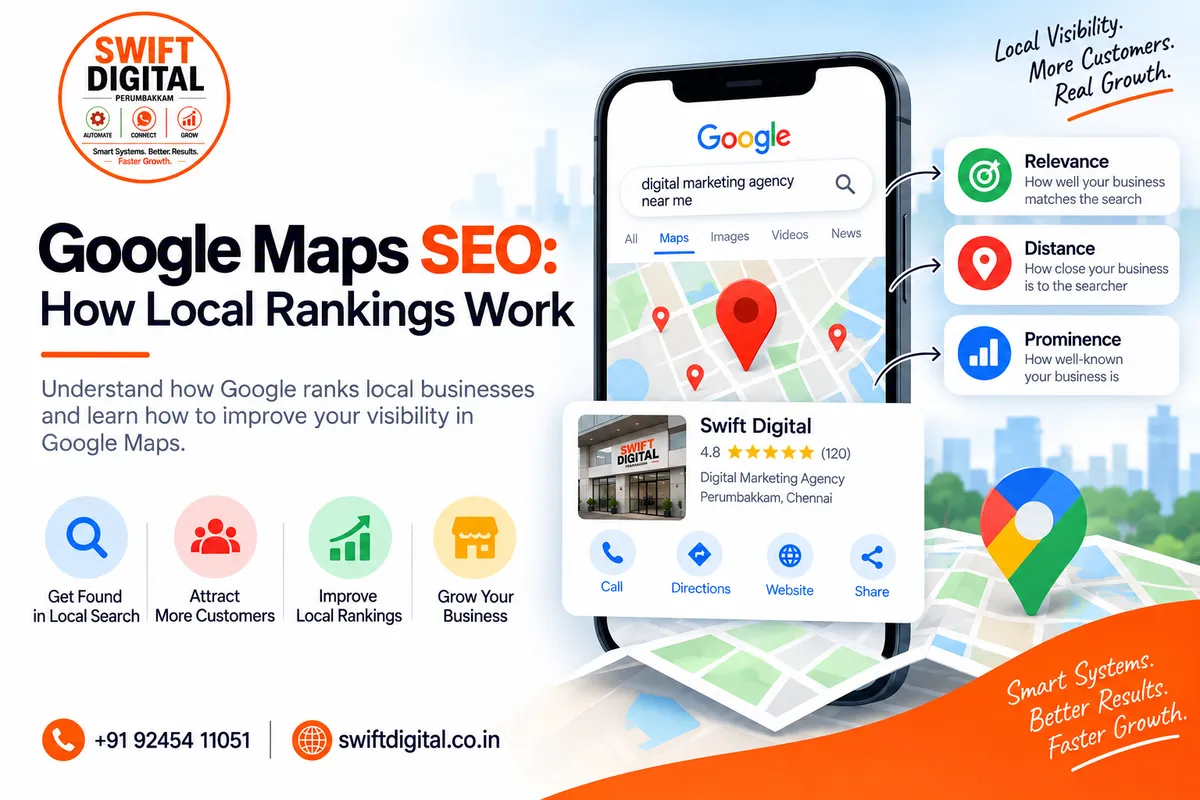
Google states that local results are mainly based on relevance, distance, and prominence. Google also says businesses cannot request or pay for a better organic local ranking.
This guide explains how Google Maps SEO works and what businesses can do to build a stronger, more accurate local search presence.
What Is Google Maps SEO?
Google Maps SEO is the process of improving a business's visibility in Google's local search results, particularly Google Maps and the local results that appear in Google Search.
It involves improving the information Google uses to understand your business, including:
Business category
Business name
Services
Business description
Address or service area
Opening hours
Website
Reviews
Photos
Other information available across the web
Google gathers business information from multiple sources, including business owners, publicly available web content, third-party data, and user contributions.
How Google Maps Rankings Work
Google identifies three primary factors for local ranking:
1. Relevance
2. Distance
3. Prominence
These factors work together rather than operating as three completely separate ranking systems.
Let's look at each one.
1. Relevance
Relevance describes how closely a Business Profile matches what a customer is searching for.
For example, suppose someone searches:
"Google Business Profile optimization agency"
Google needs to determine which businesses are relevant to that search.
A profile with complete and accurate information about its services and business category gives Google more information to understand what the business does.
Google specifically recommends providing complete and detailed business information to help it understand a business and match it with relevant searches.
How to Improve Relevance
Make sure your profile accurately communicates:
What your business does
Your primary category
Additional relevant categories
Services
Business description
Website content
Business location or service area
Opening hours
For example, a digital marketing agency could accurately describe services such as:
Local SEO
Google Business Profile optimization
SEO consulting
Website development
Social media marketing
Don't add unrelated services simply because people search for them.
2. Distance
Distance refers to how far a business is from the location associated with the search.
Google explains that if a customer doesn't specify a location, it can use information about the customer's location when determining distance.
This is why two customers searching for the same service can see different local results.
For example:
Customer A:
Searching from Perumbakkam
Customer B:
Searching from another part of Chennai
The local results may differ because the businesses' distances from those search locations differ.
Can You Optimize Distance?
Distance is different from many other SEO factors because a business generally cannot "optimize" its way around physical geography.
You should use your real business location or accurate service area.
Don't:
Create fake locations
Use virtual offices as fake storefronts
Add locations where you don't actually operate
Create duplicate profiles for the same location
Accurate location information is essential for maintaining a compliant Business Profile. Google requires businesses to provide accurate information about their location and eligibility.
3. Prominence
Prominence refers to how well-known a business is.
Google says prominence can be influenced by information such as links to the business, reviews, and other information available across the web.
This is where broader local SEO becomes important.
Businesses can build prominence through legitimate activities such as:
Earning genuine customer reviews
Building relevant website authority
Earning legitimate local links
Maintaining consistent business information
Creating useful website content
Building a recognizable local presence
Prominence is not simply about having the largest number of reviews or backlinks.
Google Maps SEO Is More Than Your Business Profile
Your Google Business Profile is important, but local SEO shouldn't stop there.
Google says information used in local listings can come from:
Your official website
Publicly available information
Third-party sources
Users
Business owners
Other interactions with a local place or business
That means your broader online presence can contribute to how Google understands your business.
Optimize Your Google Business Profile
Start with the foundation.
Make sure your profile contains accurate:
Business name
Primary category
Additional categories
Address
Service area
Phone number
Website
Hours
Services
Business description
Photos
Other applicable attributes
Google recommends keeping business information complete and accurate because this helps customers understand what the business does, where it is, and when they can visit.
Choose the Right Primary Category
Your primary category is one of the important ways Google understands your business.
Choose the category that most accurately represents your main business.
For example, if your company primarily provides digital marketing services, an appropriate category might be a marketing-related category available in Google's category list.
Don't select a category simply because you believe it has more search volume.
The category should accurately represent your business.
Add Relevant Services
Services provide additional information about what your business offers.
For example:
Local SEO Agency
Services might include:
Google Business Profile Optimization
Local SEO
Google Maps SEO
Citation Management
Local SEO Audits
Your services should be genuine and relevant.
Avoid creating dozens of keyword variations that don't represent actual services.
Keep Your Business Information Accurate
Accuracy matters for both customers and search engines.
Regularly check:
Phone number
Address
Website URL
Hours
Holiday hours
Categories
Services
Service areas
Google provides tools for verified businesses to edit and maintain their Business Profile information.
Build a Strong Local Website
Your website is an important part of your local SEO ecosystem.
Create useful pages around the services you actually provide.
For example:
Homepage
/
Google Business Profile Optimization
/google-business-profile-optimization
Local SEO
/local-seo
Google Maps SEO
/google-maps-seo
Location Page
/locations/perumbakkam
Don't create hundreds of nearly identical location pages simply to target keywords.
Each page should provide genuinely useful information for the customer.
Maintain NAP Consistency
NAP stands for:
Name
Address
Phone
Your important business information should be consistent across legitimate websites and directories.
For example, avoid having:
Website:
Swift Digital
Directory A:
Swift Digital Marketing
Directory B:
Swift Digital Chennai
Directory C:
Swift Digital Pvt Ltd
when these variations don't represent the real-world business name.
Your goal is accurate and consistent business information—not creating additional keyword variations.
Get Genuine Customer Reviews
Reviews are part of Google's local ranking guidance.
Google states that reviews and positive ratings can help a business's local ranking, while also emphasizing that local ranking depends on multiple factors.
A sustainable review strategy includes:
Asking genuine customers for feedback
Making the review process easy
Sharing your review link
Using a review QR code where appropriate
Responding professionally
Learning from customer feedback
Don't:
Buy reviews
Create fake reviews
Offer incentives for reviews
Ask only for positive reviews
Manipulate customer feedback
Respond to Customer Reviews
Responding to reviews gives your business an opportunity to communicate publicly with customers.
For a positive review:
Thank you for sharing your experience. We really appreciate your support and look forward to serving you again.
For a negative review:
Thank you for your feedback. We're sorry your experience didn't meet expectations. Please contact us directly so we can understand what happened and see how we can help.
Google recommends responding to reviews as part of maintaining your Business Profile.
Add High-Quality Photos and Videos
Photos can help customers understand your business before they contact you.
Depending on your business, consider adding:
Exterior photos
Interior photos
Team photos
Product photos
Service photos
Work samples
Equipment
Before-and-after images where appropriate
Videos
Google specifically recommends adding photos and videos to show customers what your business offers.
Use genuine images of your actual business rather than misleading stock imagery.
Build Local Authority
Prominence can extend beyond your Business Profile.
Consider legitimate opportunities such as:
Local business associations
Industry organizations
Local news coverage
Community sponsorships
Relevant business directories
Local partnerships
Industry publications
Genuine local relationships
The goal is to earn legitimate recognition and links—not manufacture backlinks.
Avoid:
Paid link schemes
Private blog networks
Bulk spam directories
Automated backlink packages
Irrelevant guest-post networks
Create Useful Local Content
Local content can help demonstrate your expertise and relevance.
Examples include:
Local Guides
How to Choose a Digital Marketing Agency in Chennai
Service Guides
Google Business Profile Optimization: Complete Guide
Educational Content
How Google Maps Local Rankings Work
Local Business Resources
Local SEO Checklist for Chennai Businesses
The content should be useful to the target audience rather than simply repeating location keywords.
Track Your Google Business Profile Performance
Don't rely only on searching your own business name.
Google Business Profile Performance can provide information about how customers discover and interact with your profile.
Depending on the profile, available metrics can include:
Searches
Views
Interactions
Website clicks
Calls
Direction requests and other actions
Google notes that performance data is available for verified Business Profiles and that available metrics can vary by business.
Monitor Search Queries
Google's Performance report includes information about searches that led to your Business Profile appearing.
These queries can help you understand how customers discover your business.
For example, you might discover that customers are finding you through searches related to:
Google Business Profile
Local SEO
SEO agency
Marketing agency
Google Maps SEO
Use this information as insight—not as a reason to stuff those terms into your profile.
Google states that businesses cannot directly manage these search queries.
Why You May Not See Your Business Ranking #1
Many business owners search for themselves and ask:
"Why am I not #1 on Google Maps?"
There are several possible reasons.
Different Search Location
Local results can vary based on where the search is performed.
Different Search Intent
"SEO agency" and "Google Business Profile optimization" may produce different results.
Different Business Relevance
A business that more closely matches a particular query may appear higher.
Distance
A competitor may be closer to the searcher.
Prominence
Another business may have stronger signals of prominence.
Google's local ranking system considers these factors together.
There Is No Guaranteed Google Maps #1 Position
Be cautious of anyone promising:
"Guaranteed #1 Google Maps ranking."
Google explicitly states that there is no way to request or pay for a better local ranking.
A responsible local SEO strategy should focus on improving the underlying business and its online presence rather than promising a specific ranking position.
Google Maps SEO Checklist
Use this checklist to review your local SEO foundation:
Business Profile
Profile claimed
Profile verified
Real business name
Correct primary category
Relevant additional categories
Accurate address
Accurate service area
Correct phone number
Correct website
Accurate business hours
Relevant services
Complete description
Appropriate attributes
Reputation
Genuine review process
Review link available
Customers can easily leave feedback
Reviews receive professional responses
Policy-violating reviews reported appropriately
Visual Content
Exterior photos
Interior photos
Product/service photos
Team photos where appropriate
Videos where useful
Website
Mobile-friendly
Clear contact information
Service pages
Relevant local content
Consistent business information
Appropriate structured data
Search Console connected
Local Authority
Legitimate citations
Relevant local directories
Industry associations
Local partnerships
Genuine local backlinks
Useful community content
30-Day Google Maps SEO Action Plan
Week 1: Profile Foundation
Verify your Business Profile
Check business name
Review primary category
Review additional categories
Check phone and website
Verify business hours
Review service areas
Add relevant services
Week 2: Content & Reputation
Review business description
Upload genuine business photos
Create a review request process
Respond to existing reviews
Check your service information
Week 3: Website & Local SEO
Review NAP consistency
Check website contact information
Review service pages
Improve internal links
Check local landing pages
Review structured data
Check Search Console
Week 4: Authority & Measurement
Review legitimate local citations
Identify relevant local organizations
Look for genuine partnership opportunities
Check Business Profile Performance
Record search queries and customer actions
Identify areas requiring improvement
Frequently Asked Questions
What are the main Google Maps ranking factors?
Google says local results are mainly based on relevance, distance, and prominence.
Can I pay Google to rank #1 on Maps?
There is no way to request or pay for a better organic local ranking. Paid advertising is a separate system from organic local rankings.
Do Google reviews affect local ranking?
Google states that review count and positive ratings can help a business's local ranking. Reviews are one component of the broader prominence factor.
Does distance matter for Google Maps?
Yes. Google identifies distance as one of the primary factors used in local results.
Can I create a fake location to rank in another city?
Your location and service area should accurately represent where your business operates. Creating misleading locations is not a sustainable or compliant local SEO strategy.
How long does Google Maps SEO take?
There is no universal timeframe for achieving a particular local ranking. Google uses multiple factors, and results can vary by business, query, competition, and search location.
Can I guarantee a #1 Maps ranking?
No responsible SEO strategy can guarantee a specific Google Maps position. Google says its local ranking algorithm details are kept confidential and businesses cannot request or pay for better organic ranking.
Final Thoughts
Google Maps SEO is not about finding a single ranking trick.
It's about building a business presence that accurately communicates:
What you do → Where you operate → Who you serve → Why customers should trust you.
Start with an accurate and complete Google Business Profile. Choose relevant categories, clearly describe your services, maintain accurate information, collect genuine customer reviews, publish useful content, strengthen your website, and build legitimate local authority.
Most importantly, remember the three core concepts Google identifies for local ranking:
Relevance + Distance + Prominence
Use these principles to guide your local SEO strategy rather than chasing shortcuts or guaranteed ranking promises.


