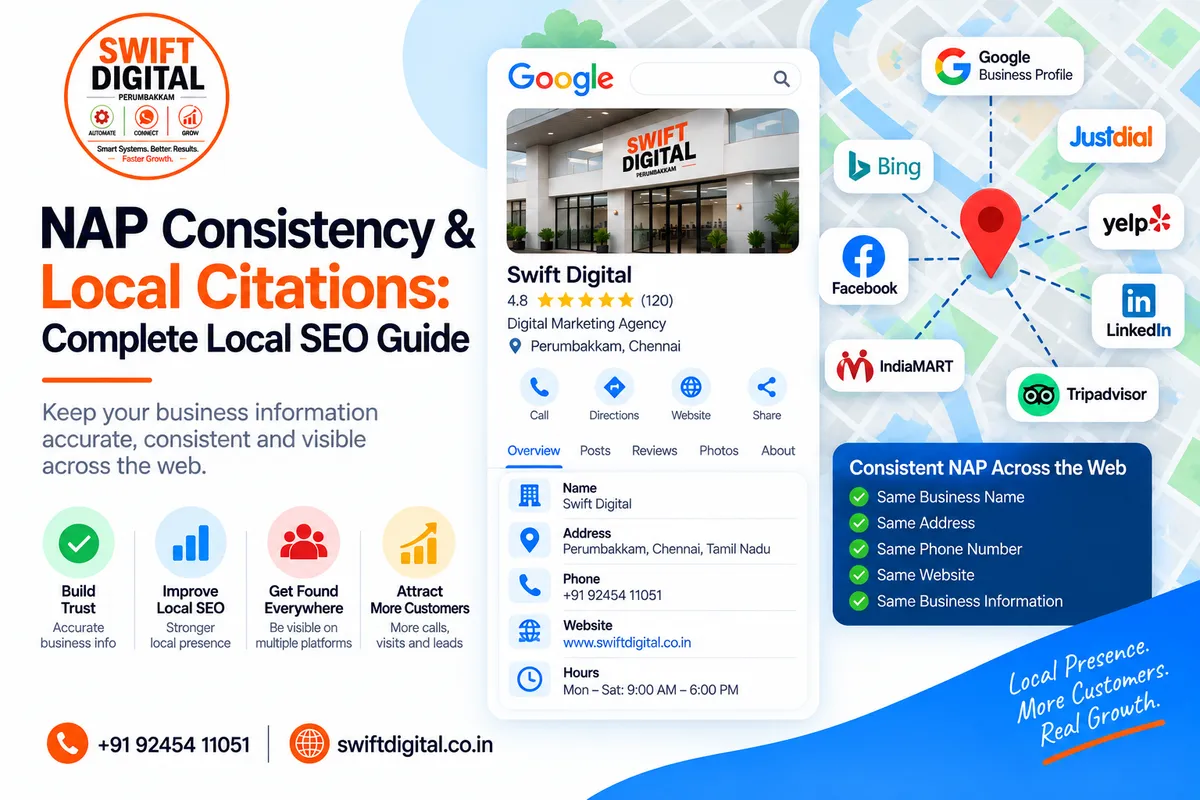
NAP Consistency & Local Citations: Local SEO Guide
When customers search for a local business, Google needs reliable information about who the business is, where it operates, and how customers can contact it.
This is why accurate business information matters across your Google Business Profile, website, directories, social profiles, industry websites, and other legitimate online sources.
Google explains that Business Profile information is compiled from multiple sources, including the business itself, publicly available information, licensed third-party data, and user contributions.
Two important concepts in local SEO are:
NAP consistency and local citations.
This guide explains what they mean, why accuracy matters, how to audit them, and how to build a clean local citation profile.
What Is NAP?
NAP stands for:
N — Name
A — Address
P — Phone Number
For example:
Business Name:
Swift Digital
Address:
Your accurate business address
Phone:
+91 XXXXX XXXXX
These details should accurately represent the real-world business.
Google's Business Profile guidelines state that a business name should reflect its real-world name and that the address or service area should be accurate.
What Is NAP Consistency?
NAP consistency means that your important business information is accurately represented across the websites and platforms where your business appears.
For example, suppose your official business information is:
Swift Digital
[Official business address]
+91 XXXXX XXXXX
You don't want legitimate business directories to contain completely different information.
Examples of potential problems include:
Old phone number
Old address
Incorrect business name
Wrong website
Duplicate listings
Incorrect opening hours
Former location still listed
Different business information across important profiles
The objective is not to make every platform visually identical.
The objective is to ensure that important business information is accurate and consistent with the real business.
What Are Local Citations?
A local citation is a reference to a business's information on another website or platform.
A citation may contain:
Business name
Address
Phone number
Website
Business category
Other business information
Examples can include:
Local business directories
Industry directories
Chamber or association websites
Professional organizations
Local publications
Relevant business listings
Social profiles
Review platforms
Google says it can use publicly available information and third-party data when compiling information about local businesses.
Why Are Local Citations Important?
Citations can help create a more consistent online presence for your business.
They can also help customers discover your business outside Google.
For example, someone might discover your business through:
A local directory
An industry association
A professional organization
A local publication
The important principle is quality and accuracy rather than quantity.
You don't need hundreds of random directory listings.
Are Citations a Direct Google Ranking Factor?
Be careful with claims that:
"More citations automatically mean higher Google Maps rankings."
Google's official local ranking guidance identifies relevance, distance, and prominence as the primary factors for local results. Google also says prominence can be influenced by information such as websites linking to your business and reviews.
Google also explains that business information can come from multiple sources, including third parties and publicly available web content.
Therefore, citations are better understood as part of your broader local online presence and business-information ecosystem, rather than a guaranteed ranking shortcut.
NAP Consistency and Google Business Profile
Your Google Business Profile should contain your authoritative business information.
Check:
Business name
Address
Phone
Website
Hours
Service area
Business category
Google says complete and accurate Business Profile information can help businesses appear in relevant local searches.
Your other online profiles should not contradict the real information represented by your business.
Business Name Consistency
Use your actual business name.
For example:
Correct:
Swift Digital
Don't turn your business name into:
Swift Digital Best SEO Company Perumbakkam Chennai
unless that is genuinely the business's real-world name.
Google's guidelines specifically prohibit adding unnecessary information to a Business Profile name, including unnecessary location or service keywords.
The same principle applies when creating directory listings.
Address Consistency
Your address should accurately represent the real-world business location.
Avoid changing the address format simply to insert keywords.
For example, don't turn:
123 Main Street
into:
Best SEO Agency Near Main Street, Chennai
The address should contain actual address information.
Google's guidelines require businesses to use an accurate physical address where an address is displayed.
Phone Number Consistency
Use a phone number that actually connects to the business.
Google's guidelines say the phone number should be under the direct control of the business and, where possible, use a local phone number rather than a central call-center number.
If your business changes its primary phone number, update important online profiles.
Website Consistency
Your website should clearly represent the same business as your Business Profile.
Check that:
Business name is consistent
Contact information is accurate
Address is accurate where displayed
Phone number is accurate
Website belongs to the business
Service information is consistent
Google's business eligibility guidance says the website and phone number associated with a Business Profile should be the authoritative ones for that business and verifiable by the business owner.
Local Citation Examples
Depending on your country, industry, and location, relevant citation opportunities may include:
General Business Directories
Local business directories
Regional directories
Business listing platforms
Industry Directories
For example:
Marketing directories
Legal directories
Medical directories
Construction directories
Professional associations
Local Organizations
Potential opportunities include:
Chamber of commerce
Business associations
Local trade groups
Community organizations
Review Platforms
Depending on your industry, customers may use:
Google
Industry-specific review websites
Local review platforms
Don't create listings simply because a website accepts submissions.
Choose platforms that are legitimate and relevant.
How to Audit Your NAP
A NAP audit involves checking important business listings and comparing them against your authoritative business information.
Create a spreadsheet with columns such as:
Platform | Business Name | Address | Phone | Website | Status | Action |
|---|---|---|---|---|---|---|
Correct | Correct | Correct | Correct | Active | None | |
Directory A | Incorrect | Correct | Old | Correct | Active | Update |
Directory B | Correct | Old | Correct | Correct | Active | Update |
Industry Site | Correct | Correct | Correct | Correct | Active | None |
This gives you a central record of your citation profile.
Step 1: Establish Your Authoritative NAP
Before correcting listings, decide what information is actually correct.
Use the current real-world business information.
Record:
Business Name:
[Official Business Name]
Address:
[Official Address]
Phone:
[Official Phone]
Website:
[Official Website]
Hours:
[Current Business Hours]
This becomes your reference document.
Step 2: Audit Google Business Profile
Start with your Google Business Profile.
Check:
Name
Address
Phone
Website
Hours
Category
Service area
Google allows verified businesses to manage their Business Profile information through Google Search and Maps.
Step 3: Audit Your Website
Check your:
Homepage
Contact page
Footer
About page
Location pages
Service pages
Schema markup
Make sure important business information is accurate.
If your business information has changed, update the website before working through external listings.
Step 4: Find Existing Citations
Search for your business using combinations such as:
"Business Name"
"Business Name" + phone number
"Business Name" + city
"Business Name" + address
Also search for old information:
"Old Business Name"
"Old Phone Number"
"Old Address"
This can uncover outdated listings.
Step 5: Categorize Your Listings
Divide listings into:
Correct
No changes required.
Incorrect
Information needs to be updated.
Duplicate
Multiple listings represent the same business.
Unclaimed
The listing exists but isn't managed.
Irrelevant
The website is unrelated or low-value.
Suspicious/Spam
The listing may be part of a spam network or misleading directory.
Don't automatically submit your business to every website you find.
Step 6: Correct Important Listings
Prioritize listings that:
Customers actually use
Are relevant to your industry
Are relevant to your location
Have strong reputation
Appear in branded searches
Contain important business information
Update incorrect information where possible.
Duplicate Listings
Duplicate listings can create confusion.
For example:
Listing A:
Swift Digital
Listing B:
Swift Digital Marketing
If both represent the same real-world business and location, investigate whether the second listing is a duplicate.
Don't create additional profiles simply to occupy more search results.
Google's guidelines state that there should generally be only one Business Profile per business, subject to specific exceptions.
Don't Create Fake Locations
One of the biggest local SEO mistakes is creating fake locations.
For example:
Swift Digital — Chennai
Swift Digital — Bangalore
Swift Digital — Hyderabad
when the business doesn't actually operate at those locations.
Google requires Business Profiles to accurately represent real-world businesses and locations.
A sustainable local SEO strategy should never depend on fake addresses.
Service-Area Businesses and Citations
A service-area business may not have a customer-facing storefront.
Google allows eligible service-area businesses to create a Business Profile and hide their address from customers when appropriate.
For these businesses, accuracy is especially important.
Don't invent office locations simply because you want to rank in another city.
Instead, accurately communicate:
Business name
Phone
Website
Service area
Services
Other legitimate business information
Local Citations vs Backlinks
These are related but different concepts.
Citation
A website mentions your business information.
Example:
Swift Digital
Chennai
+91 XXXXX XXXXX
Backlink
Another website provides a clickable link to your website.
Example:
Visit Swift Digital
A citation may include a link, but a citation and a backlink aren't automatically the same thing.
Google's local ranking guidance notes that prominence can involve information such as how many websites link to a business.
Build Quality Citations, Not Spam Citations
Avoid services promising:
"10,000 local citations for ₹999"
Large quantities of low-quality listings don't automatically create a stronger local presence.
Instead, prioritize:
Relevant directories
Legitimate local organizations
Industry associations
Reputable business platforms
Real community resources
Your goal should be accuracy, relevance, and trust.
Keep Citations Updated
A citation audit shouldn't happen only once.
Review your important listings when:
Business name changes
Address changes
Phone number changes
Website changes
Business hours change
Business ownership changes
You move location
You expand to another legitimate location
Google can also update Business Profile information using other sources when it detects information that may be outdated or incorrect.
This makes ongoing monitoring useful.
What If Google Changes Your Information?
Google may update Business Profile information based on information from other sources.
Google explains that profile updates can come from sources such as user reports and licensed content.
If you notice an incorrect update:
Review the information.
Verify your authoritative business details.
Correct the Business Profile.
Check important external sources.
Investigate whether conflicting information exists elsewhere.
Don't simply keep changing the profile repeatedly without identifying the underlying inconsistency.
NAP Consistency for Multi-Location Businesses
If your business has multiple genuine locations, each location should have accurate information.
For example:
Location 1
Swift Digital
Chennai
Phone A
Location 2
Swift Digital
Bangalore
Phone B
Don't mix the address or phone number between locations.
Google's guidelines contain specific requirements for businesses with multiple locations, and each eligible location should accurately represent the business operating there.
NAP and Schema Markup
Your website can also communicate business information through structured data.
For eligible local businesses, LocalBusiness structured data can communicate information such as:
Business name
Address
Phone
URL
Opening hours
However, structured data should represent the actual information visible and applicable to your business.
Don't use schema to create fictional locations or information.
Schema is a communication mechanism—not a way to manufacture local ranking signals.
NAP Consistency Checklist
Business Name
Real-world business name
Consistent across important platforms
No unnecessary keywords
No fake location variations
Address
Accurate
Current
Complete where appropriate
Matches real-world location
No keyword stuffing
Phone
Current
Directly controlled by business
Correct across important listings
Website
Correct URL
Business-owned
Represents the same business
Contact details are accurate
Citations
Important directories audited
Industry listings checked
Local listings checked
Duplicate listings identified
Incorrect information corrected
Spam listings avoided
30-Day NAP & Citation Action Plan
Week 1 — Build the Master Record
Create your authoritative information sheet containing:
Business name
Address
Phone
Website
Hours
Primary category
Service area
Then audit your Google Business Profile and website.
Week 2 — Citation Audit
Find existing listings.
Search for:
Business name
Business name + city
Phone number
Old business name
Old phone number
Old address
Record everything in a spreadsheet.
Week 3 — Corrections
Prioritize important listings.
Correct:
Name
Address
Phone
Website
Hours
Investigate duplicates.
Week 4 — Quality & Monitoring
Identify legitimate citation opportunities.
Consider:
Local business organizations
Industry associations
Relevant directories
Community websites
Professional platforms
Then establish a recurring citation audit process.
Frequently Asked Questions
What does NAP stand for?
NAP stands for Name, Address, and Phone Number.
Why is NAP consistency important?
It helps maintain accurate business information across your online presence. Google uses information from multiple sources when compiling local business information.
Are citations a guaranteed Google Maps ranking factor?
No. Google identifies relevance, distance, and prominence as the primary factors for local ranking. Citations should not be treated as a guaranteed ranking shortcut.
How many citations does a business need?
There is no universal number that guarantees better rankings.
Focus on relevant, legitimate, accurate listings rather than maximizing quantity.
Should I submit my business to every directory?
No. Prioritize legitimate directories relevant to your industry, location, or customers.
What should I do if I find an old phone number online?
Update important legitimate listings where possible and check whether other sources still contain the old information.
Should my business name include my location keyword?
Only if the location is genuinely part of the real-world business name. Google prohibits adding unnecessary information to a Business Profile name.
Can I create multiple Google Business Profiles for different cities?
Only for genuine eligible locations that meet Google's requirements. Creating fake locations for ranking purposes is not compliant.
Final Thoughts
NAP consistency and local citations are about one fundamental principle:
Make your business information accurate, trustworthy, and easy to understand wherever customers and search engines encounter it.
Start with your authoritative business information.
Then check your Google Business Profile, website, directories, industry listings, local organizations, and other important platforms.
Correct outdated information, investigate duplicates, avoid spam directories, and never create fake locations.
Remember that citations aren't a magic formula for Google Maps rankings. Google's local ranking guidance focuses on relevance, distance, and prominence, while Google also gathers business information from multiple sources across the web.
A clean, accurate local presence is therefore best treated as part of your broader local SEO foundation.


